KEY STAGE 1 AND 2 · TERMLY
Creative Enrichment Workshops
Four crafts, taught properly, by people who do them
How They Work
Each workshop runs as a termly block, so a child builds a real skill rather than samples one. Groups are small, every session ends with something made or performed, and you need not attend our mornings to join an afternoon. Open to home educating, flexi-schooling and full-time educated children alike.
Afternoon Workshops
I.
Textiles in Craft
See days & times →
Weaving, stitching and printing: the old crafts, taught by hand.
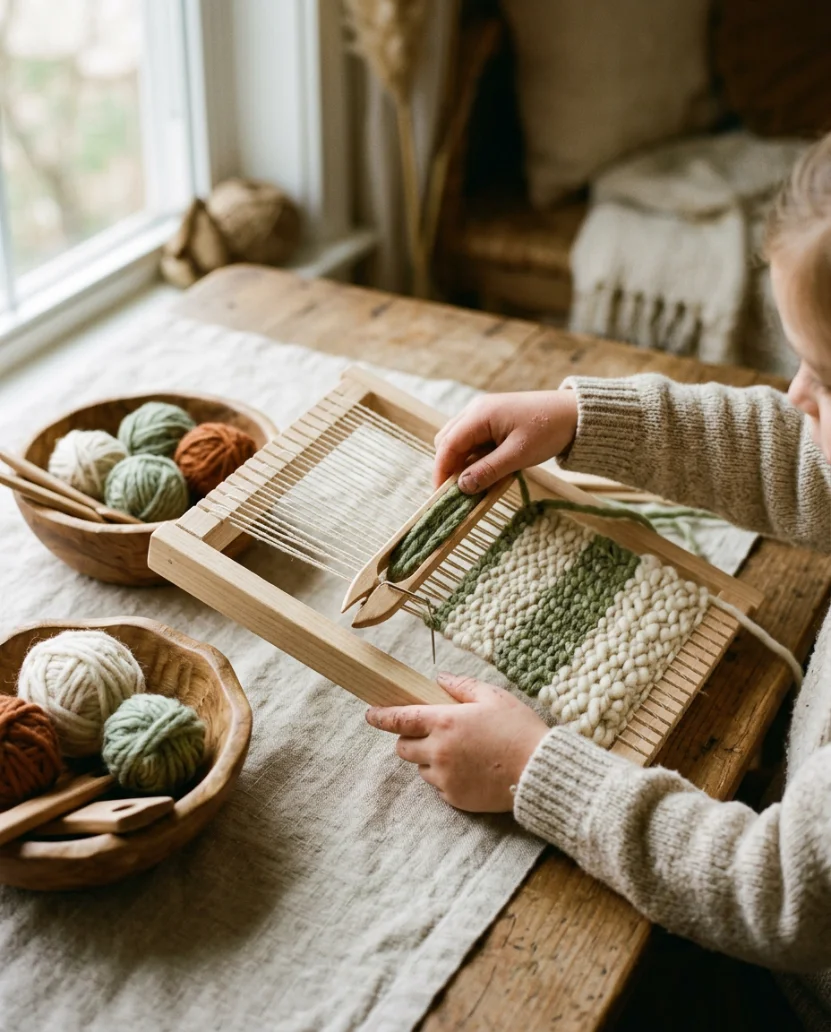
This foundational course offers a gentle introduction to textile crafts, tailored to the developmental needs of Key Stage 1 and 2 children. By engaging with fabric, wool, and thread, students will build essential fine motor coordination, spatial awareness, and concentration in a supportive environment.
A calm, absorbing workshop in making things properly by hand. Over the term children move from raw yarn to finished, useful objects.
It is slower work than most children are used to, and that is the point. Textile craft builds the fine motor control, patience and sequencing that make writing, tying and building easier, and it gives a child the quiet satisfaction of finishing something that did not exist that morning.
Course Objectives & Activities:
Fibre & Texture Exploration: Understanding how different materials feel and behave.
Hand-Eye Coordination: Navigating basic hand-sewing stitches (running stitch, blanket stitch) on loose-weave fabrics using child-safe needles.
Looping & Knotting: Introducing the fundamental mechanics of knitting and crocheting through finger knitting and yarn play.
Confidence in Creating: Following simple multi-step processes to plan, design, and finish a small project from scratch.
Included. All fabrics, yarns, felt, child-safe needles and tools. Projects are paced so every child finishes, and takes home, their own handmade pieces.
Good for. Children who like making, fiddling, sorting, and getting absorbed in something.

This foundational environmental science course sits where botany meets everyday use. Through the study of herbs, wild edibles and cultivated plants, children build early skills in scientific classification, plant anatomy and ecological awareness.
YOUNG PLANT SCIENTISTS WILL EXPLORE
I.Plant anatomy and function. Investigating roots, stems, leaves and flowers to see how edible plants move water and make their own food.
II.Identification and sorting. Using visual guides to identify safe herbs and common wild plants by leaf shape, margin and branching pattern.
III.The science of scent. Exploring the essential oils in herbs, and why plants evolve particular smells to attract pollinators or deter pests.
IV.Seasonal lifecycles. Following edible plants from flower to seed, and how the seasons shape what can be grown and harvested.
V.The five senses of herbs. Meeting mint, rosemary and lemon verbena, and discovering how strong scents and textures help plants protect themselves.
VI.Kitchen chemistry and herbal brews. Brewing simple herbal teas, making natural plant dyes, and crushing seeds to see what is hidden inside.
Included. All ingredients, tools and seeds, and a nature journal for the term's findings. Allergy and dietary forms are required before week one, and all tasting is supervised.
Good for. Children who ask why, love to smell and touch everything, and want to know how things work.
After-School Clubs
III.
Choir & Music Exploration
See days & times →
Introducing young singers to the fundamentals of music through their most natural instrument, their voice.
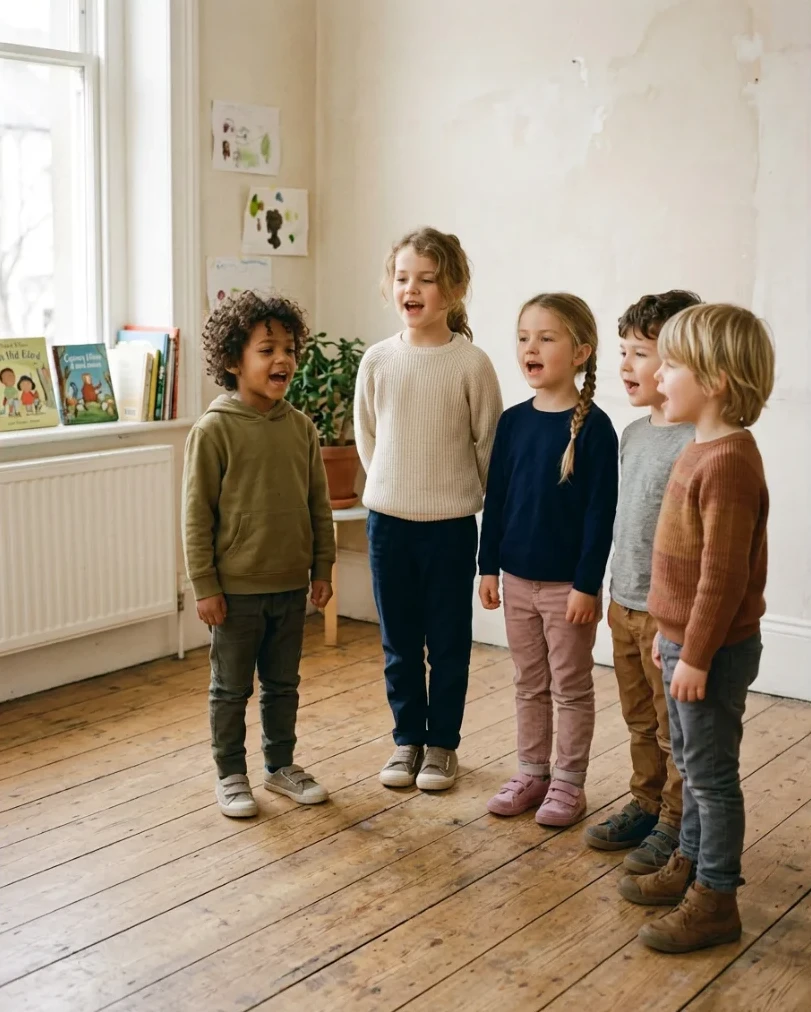
A joyful choir for children who love to sing, and for children who have never tried. No auditions, no music reading, no experience required. We shake off the day, then spend the hour playing with the most portable instrument a child owns.
Through vocal games, body percussion and a mix of folk songs, echo songs and simple rounds, children find their singing voice safely, hold a steady pulse, follow a conductor and blend with the people either side of them. Singing together teaches listening, timing and cooperation as little else does, and it sends them home having made something genuinely good.
OUR ENSEMBLE WILL EXPLORE
I.Vocal discovery. Playful warm-ups that teach children to find their singing voice, manage their breath and sing safely.
II.Rhythm and movement. Hand percussion (shakers, drums) and body percussion (claps, stomps) to internalise a steady beat and musical patterns.
III.A varied repertoire. A colourful mix of seasonal songs, folk tunes, echo songs and simple two-part rounds, chosen for young ears.
IV.Listening and performance. The confidence to sing together as a team, listen to one another, and prepare a short, relaxed showcase for family and friends.
No prior singing experience or ability to read music is required. This is a supportive space designed to build social confidence, auditory processing, and a lifelong love of music.
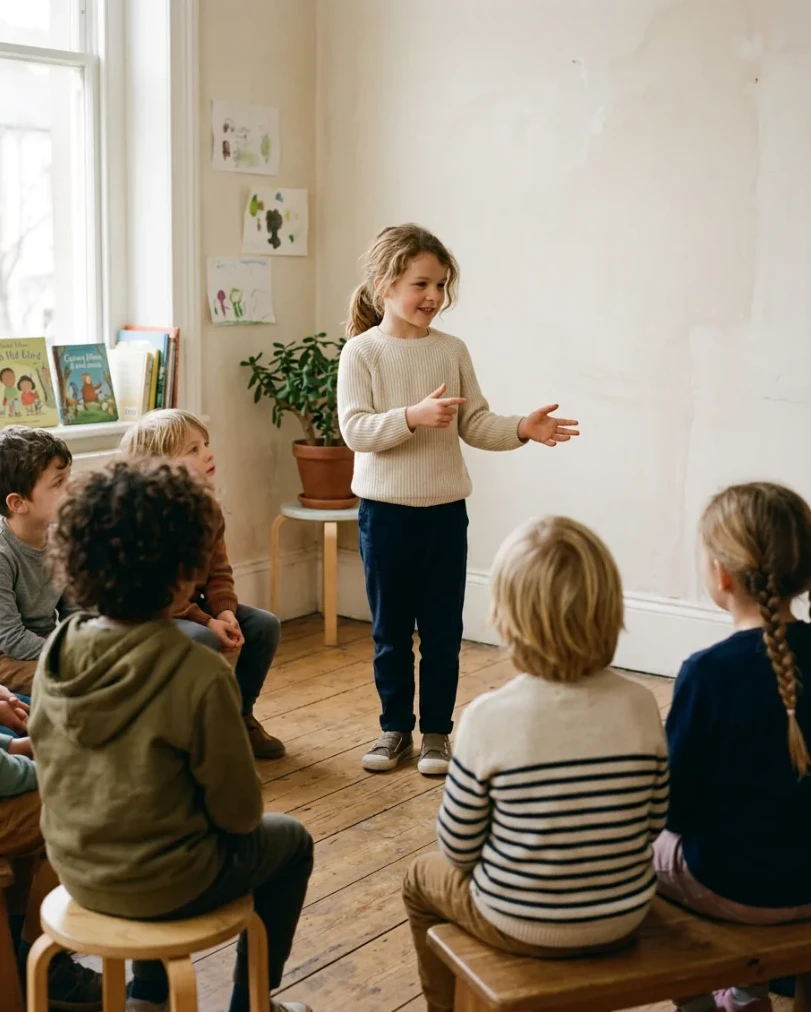
Young Orators brings storytelling to life through imaginative play. Children build the language, confidence and creative thinking to find their voice, on stage and off it. There is no singing, no dance and no chasing a starring role. The aim is oracy: the ability to think clearly, choose words well and say them with conviction, whether to one person or a full room.
In the primary years, children are wiring the skills that they will use for life: finding words, listening well, and speaking up. Each week is built around an original story rather than a script to memorise, so children are always thinking, choosing and speaking in the moment. Drama is the method, not the destination; what they take away is a richer vocabulary, a steady voice and the ease to explain, persuade and ask a good question — in the classroom, at the dinner table, and one day at interview.
EACH WEEK, OUR YOUNG ORATORS EXPLORE
I.Speech and clear speaking. Vocal games that teach projection, clear diction, and how to use expression so an audience stays hooked.
II.Creative storytelling. Stepping into the shoes of exciting characters, from brave explorers to talking animals, through guided role-play and improvisation.
III.Body language and presence. Learning to stand tall, make eye contact, and use movement to tell a story without saying a word.
IV.Teamwork and listening. Working in small groups to build short scenes, developing active listening, empathy and cooperation.
Good for. Every child, quiet or bold. A real boost in confidence now, and the voice, poise and presence of tomorrow’s leaders. No experience needed.
Booking
Spaces are limited, and kept that way
Groups are small so that every child gets real attention. Days and times for each location are on our timetable; sign-in opens five minutes before each session, and children are signed out to a named adult. Fees for each termly block are set out on the fees page.
To book, or to ask anything at all: office@hobsoneducation.com
Hobson Education
Primary Home Education Support & Creative Enrichment Workshops
© 2026 Hobson Education.